Sumo is a traditional Japanese martial art and is now one of the most recognized combat sports worldwide. The official grand tournaments, known as Honbasho (本場所), are held six times a year, with three of them taking place in Tokyo at the Kokugikan (Ryogoku Kokugikan 両国国技館). While you can watch Sumo on television, consider experiencing the excitement of live matches and the unique atmosphere of the Kokugikan from the stands.
1.When and where do the Tokyo tournaments take place?
2.What is the daily schedule of the Basho tournament?
3.What's the wrestler's ranking system to determine the order of bouts?
4.What types of seating are available at Kokugikan?
First-floor seating is in Japanese style
- Seating Type: Masu-seki seats (桝席)
- Seating Type: Tamari-seki seats (溜席)
Second Floor Seating Type: Chair seats
5.How to purchase Sumo tickets
1. When and where do the Tokyo tournaments take place?
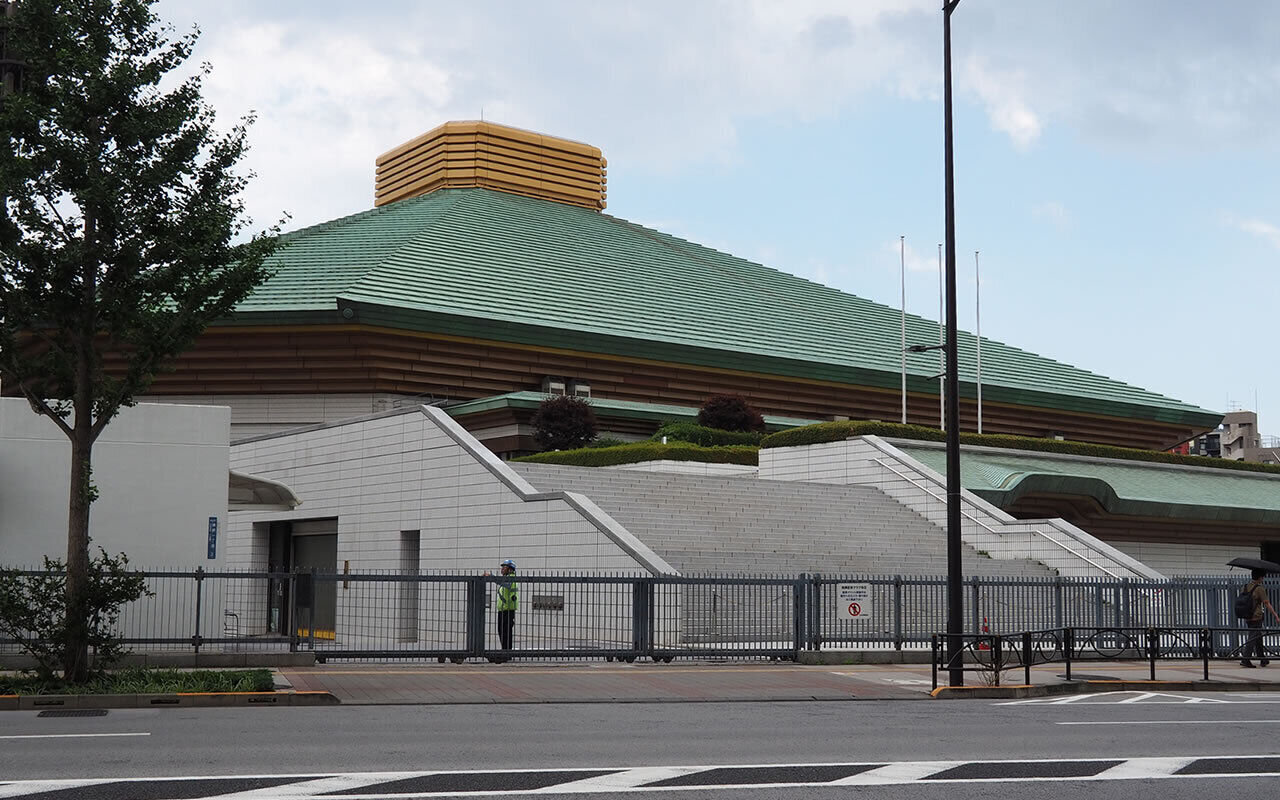
The grand tournaments held in Tokyo three times a year are called Tokyo Basho, and run for 15 days each in January, May, and September. The venue is the Kokugikan in Ryogoku town, an arena dedicated to sumo wrestling. The Kokugikan venue is located on the east side of central Tokyo, about a 2-minute walk from the west exit of Ryogoku Station on the JR Sobu Line. You can see the large green roof of the Kokugikan from the station.
2. What is the daily schedule of the Basho tournament?
During a Basho tournament, Sumo bouts take place from morning until evening. The venue opens at 8:00 AM and continues until around 6:00 PM, with two breaks in between. The bouts begin with wrestlers from lower ranks, and then higher-ranked wrestlers compete in the second half.
(Basic time table)
8:00 Gate open
8:30 Matches begin
14:20 - The wrestlers from the Juryo division come into the arena and start their matches.
15:45 - The wrestlers from the Makuuchi division come into the arena.
Yokozuna wrestlers come into the arena.
16:15 - The wrestlers from the Makuuchi division start their matches
18:00 - Ending ceremony (Yumitori: Bow-twirling ceremony)
3. What's the wrestler's ranking system to determine the order of bouts?
Sumo wrestlers' ranks, called Banzuke 番付, are determined by their strength. The Banzuke is pyramidal, with Yokozuna (横綱) at the top, and the stronger a wrestler becomes, the higher the rank they can move up to. Each rank in the Banzuke is given a name, such as Juryo (十両) or Maegashira (前頭). Additionally, wrestlers ranked higher are called Makuuchi (幕内) or Sekitori (関取), and are respected as honorable wrestlers who receive special treatment. There are about 600 sumo wrestlers in total, and only a handful are able to compete in the Basho tournaments. Furthermore, the doors to becoming a Makuuchi or Sekitori are narrow, with only 0 to 2 wrestlers reaching the top as Yokozuna.
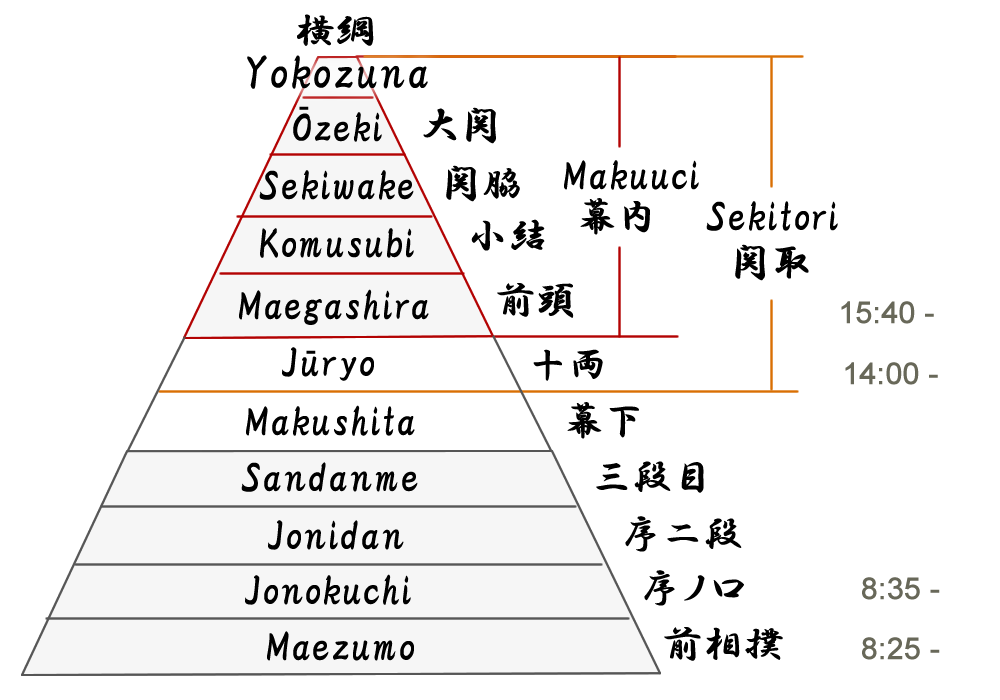
The highlights are the Juryo division bouts and the upper ranks.
To watch bouts during the Basho, you can enter the Kokugikan venue and watch the matches at any time you like. Most spectators choose to watch the afternoon Makuuchi or Sekitori bouts, as it takes much time to watch all the matches, stretching from morning to evening.
However, passionate Sumo fans arrive early in the morning to cheer on the wrestlers striving to reach the higher divisions. While the venue is a little quieter in the morning, the sounds of wrestlers clashing and the enthusiastic cheers of the fans reverberate throughout the venue, creating an unforgettable experience.
4. What types of seating are available at Kokugikan?
Kokugikan is a two-story arena with two different types of seating on each floor. The first floor has Japanese-style seating, while the second floor has seating in chairs.
First-floor seating is in Japanese style
Spectators take off their shoes and sit on the floor (excluding Box-seats (Private booth) and wheelchair seats). There are two types of first-floor seating: Masu-seki seating and Tamari-seki seating, both with cushions to sit on. In either sitting area on the first floor, it is not allowed to bring in chairs. There is a small space under the seating to put your shoes. (Boots may be too large to fit in) It is advisable to wear shoes that are easy to put on and take off, so it will be convenient when you go to the restroom or concession stand for a break.
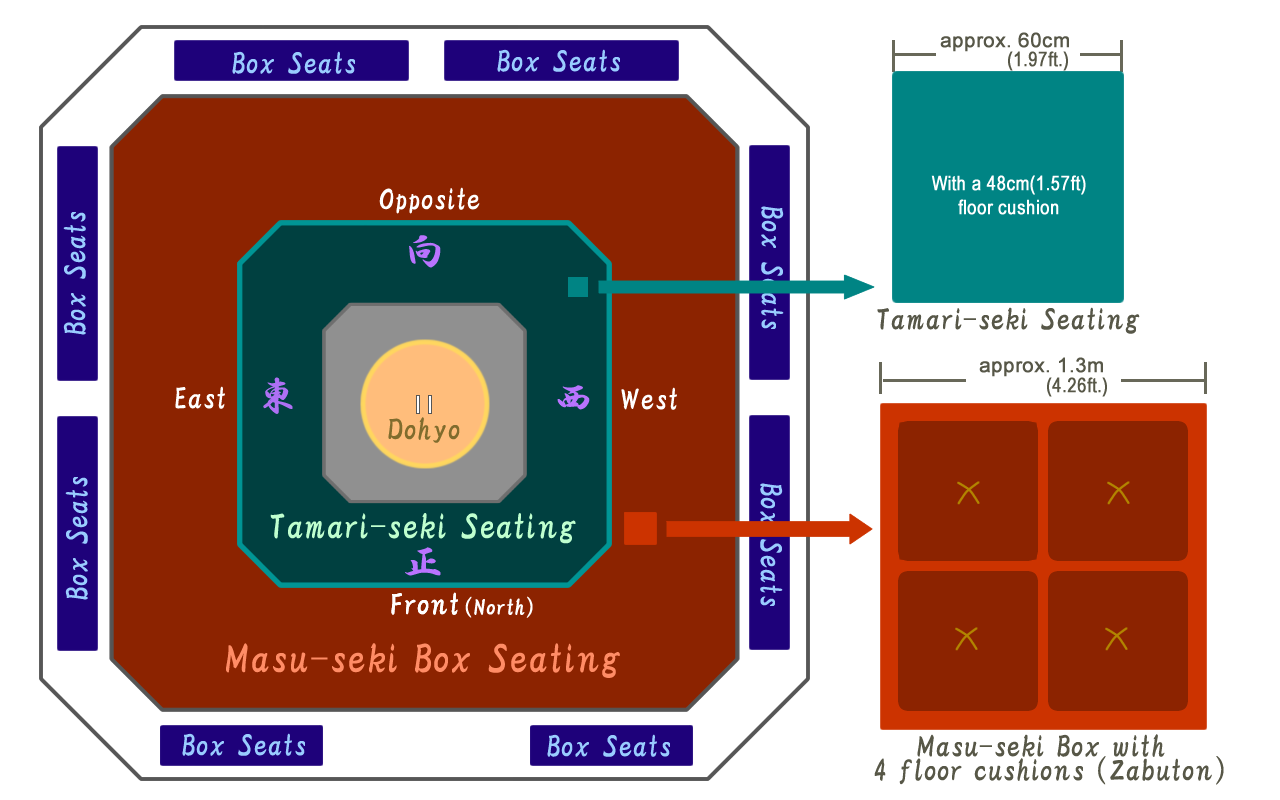
In the sumo arena, the front is north, and the east is on the left side. If two competitors have the same rank, the wrestler on the east side is ranked higher than the one on the west side.
Seating Type: Masu-seki seats (桝席)
A Masu-seki is spectator seating where multiple people can sit in a single block, provided as a square box seat. Prices of the boxes vary depending on the distance from the wrestling ring (Dohyo) and the type of seating. Each square box is generally for four people, and four cushions are provided. (Some boxes are for two or three persons.) A four-person space is 1.3 square meters, which some people may find cramped. While Masu-seki seats are purchased in groups of 4, there are also seats available for 1 or 2 people. Additionally, sharing a single box is also available.
At Masu-seki seats, you can enjoy food and drinks while watching the matches
Masu-seki seats allow spectators to enjoy food and drinks, making it a classic way to experience Sumo watching. The arena has concession stands and restaurants where spectators can get Kokugikan's specialties, such as Yakitori and Makunouchi bento. Spectators are permitted only one plastic cup of alcohol. Bottled or canned drinks are not allowed. Most spectators get food and drinks from the stands in the Kokugikan, as bringing in personal food and drinks is restricted for hygiene reasons, and it is an opportunity to enjoy Kokugikan specialties.
Masu-seki seats with a souvenir are also available.
Some Masu-seki seats come with a souvenir set, which includes a fancy bento box and snacks to enjoy at your seat, as well as sumo merchandise. The more superior the Masu-seki seat, the more luxurious the set of souvenirs, which may even include pottery and lacquerware. The Masu-seki with a souvenir included can be reserved at the same time as purchasing Masu-seki tickets. Tickets with a souvenir can also be arranged through the Sumo Information Center, known as Ochaya (Sumo Tea House: お茶屋).
Seating Type: Tamari-seki seats (溜席)
These seats are located closest to the Dohyo ring. Tamari-seki seats are also known as Sunakaburi-seki (Sand-covered seats), as the seats are so close that it seems as if sand from the ring flies over to them during bouts. Tamari-seki is premium seating, and tickets are extremely hard to come by. In the Tamari-seki seating area, each spectator is allocated about 60cm of space, where they sit on floor cushions. As a premium seat, Tamari-seki seats offer commemorative gifts, including exclusive, official merchandise by the Sumo Association, such as lacquerware, pottery, and textiles.
Eating and drinking are not allowed in the Tamari-seki seats.
Because the Tamari-seki seats are close to the ring, there is a risk of accidents such as wrestlers falling, so several restrictions have been put in place. First, eating and drinking are prohibited in the Tamari-seki seats. Photographs are also not allowed without permission. The use of phones is also prohibited. Furthermore, children under the age of 16 are not permitted to use the seats.
Second Floor Seating Type: Chair seats
All seating on the second floor is chair seating. Prices vary depending on the area. The sumo arena does not have a center-hung display, so seats in the front offer better views. Eating and drinking are permitted in the chair seats, where you can enjoy a bento, sushi, or snacks purchased from the concession stands. Unreserved seating tickets are available for purchase on the same day at the Kokugikan, starting early in the morning. These same-day tickets are so popular, leading to long lines that form very early in the morning. On the day of the final championship bouts, some people even wait in line overnight.
5. How to purchase Sumo tickets
Tickets can be purchased through the Sumo Association's website, ticket websites, the Sumo Information Center, and convenience stores (from ticket vending machines). Remember, Sumo is a popular sport, and tickets can be difficult to obtain. Tickets are sold in advance by lottery to Sumo fan club members and others, after which they become available to the general public. General tickets are available on a first-come, first-served basis starting one month before the tournament begins, so why not check the Sumo Association's website for availability around that time?
Information
Japan Sumo Association official website
https://www.sumo.or.jp/
https://www.sumo.or.jp/En/