Japan's Fire Service Act requires the installation of fire alarms in all homes. Fires can occur from careless handling of items like cigarettes and scented candles, as well as from electrical short circuits or unexpected fires caused by mobile phone batteries. Although fire alarms often go unnoticed in everyday life, their role and importance are crucial to our safety.
1. Mandatory installation of residential fire alarms
2. Types of residential fire alarms: Smoke detectors and Heat detectors
- Fire alarms come in two varieties: battery-operated and hardwired (electric)
- How to distinguish Smoke Detectors from Heat Detectors
3. Key points about Residential fire alarms
- Smoke detectors
- Heat detectors
4. What to do when an alarm falsely goes off
- For battery-operated alarms, a notification sound will indicate when the battery is low, prompting you to replace it
5. Regularly check alarm functionality
- Battery-powered alarms typically have a lifespan of about 10 years
1. Mandatory installation of residential fire alarms
The installation of fire alarms is compulsory in all types of housing, including single-family homes and apartment buildings. According to Article 17 of the Fire Service Act and local ordinances, fire alarms must be installed in bedrooms and stairwells on floors where bedrooms are located (excluding floors used for evacuation). They should also be installed in kitchens, living rooms, and other areas where fires could potentially start.
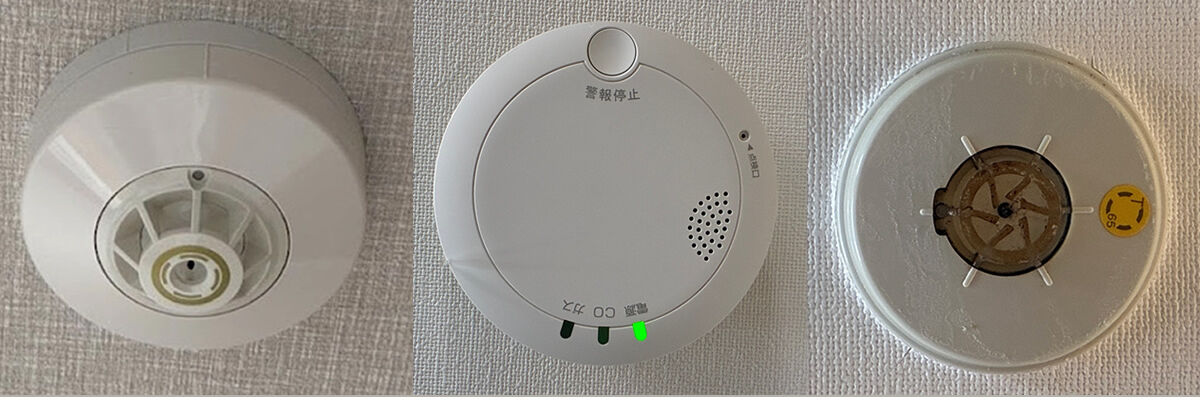
Residential fire alarms (Heat detectors)
2. Types of residential fire alarms: Smoke detectors and Heat detectors
There are two types of residential fire alarms: smoke detectors (煙感知式) and heat detectors (熱感知式). As the names imply, smoke detectors sense fire by detecting smoke, while heat detectors respond to heat. Some alarms combine both functions, making them ideal for places such as kitchens where fire risk is higher.
Smoke detection vs. Heat detection
|
|
Smoke detection |
Heat detection |
|
Functions |
Photoelectric type. It detects smoke by light refraction |
Fixed temperature type. It detects an unusual increase in the surrounding temperature. |
|
Features |
It detects fire at an early stage. |
It prevents false detection caused by smoke or steam (e.g. when cooking) |
|
Installation required/suggested |
Bed rooms, Stairs, Children's room (with beds), Living rooms |
Kitchens |
Fire alarms come in two varieties: battery-operated and hardwired (electric).
Hardwired alarms require installation of wiring, making them suitable for new constructions, while battery-operated versions are easier to retrofit and are perfect for use during home renovations.
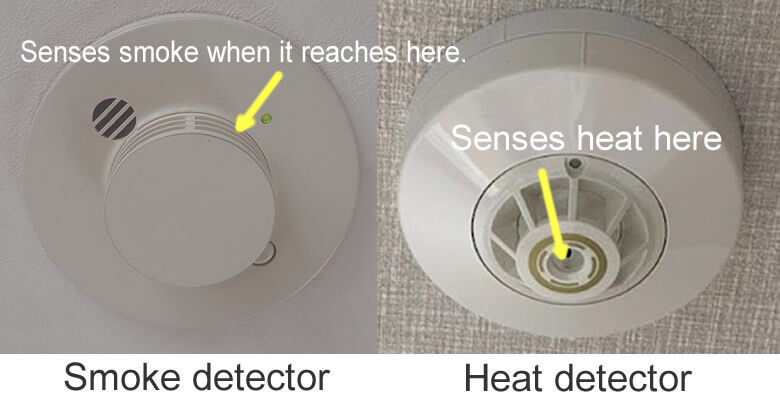
How to distinguish Smoke Detectors from Heat Detectors
To distinguish between the two types, look at the shape of the device's disc. Generally, smoke detectors feature a groove for smoke entry, while heat detectors typically have a central sensor designed to detect heat. Smoke/Heat combined detectors come with the both parts. Since fire alarms commonly have a similar round shape, it's best to consult a store clerk when purchasing to ensure you select the correct type.
Shape examples:
3. Key points about Residential fire alarms
Smoke detectors
- Fire alarms installed in bedrooms and stairwells are usually smoke detectors. Many fire-related fatalities happen while people are asleep and unable to escape.
- This is why it is mandatory to have smoke detectors in these areas to ensure that fires are detected quickly.
- Smoke detectors are designed to detect smoke and can also respond to large amounts of steam, especially when the bathroom door is left open.
- In environments where many people smoke, the detector may trigger due to the increased smoke levels.
- Over time, smoke detectors can become less sensitive due to dirt or environmental factors.
Heat detectors
- Heat detectors activate if a cooking pot on the stove overheats when left unattended.
- As heat detectors respond when rising high temperatures in the room, it may already be on fire by the time they go off.
4. What to do when an alarm falsely goes off
You can stop all types of residential fire alarms in the same way. Press the stop button on the device or pull the cord, if available, to turn off the alarm.
For battery-operated alarms, a notification sound will indicate when the battery is low, prompting you to replace it.
This low-battery alert will continue to sound until you press the stop button or pull the cord. If the batteries are not replaced after stopping the sound, it will start the sound again.
5. Regularly check alarm functionality
Periodically testing the fire alarm is vital. To check if it is working, press the alarm stop button or pull the cord, ensuring it emits a sound. It is advisable to conduct these checks every six months or so.
While there is no legal requirement to replace fire alarms periodically, components may wear out and become ineffective at detecting fires. It is suggested to replace the entire device every 10 years.
Battery-powered alarms typically have a lifespan of about 10 years.
After this time, a notification sound will alert you that the battery needs replacing. Although batteries can be replaceable, it is also a good time to replace the entire alarm unit, especially since smoke detectors can lose sensitivity over time.
Many victims of residential fires are unable to escape in time. To ensure early fire detection and a quick evacuation, make sure your fire alarm is correctly installed and fully operational.
References
Residential Smoke Alarm Device Instructions by Japan's Fire and Disaster Management Agency
https://www.fdma.go.jp/relocation/html/life/yobou_contents/materials/pdf/13_gaikokugo_en.pdf
FAQ on Residential fire alarms by Japan's Fire and Disaster Management Agency
https://www.fdma.go.jp/relocation/html/life/yobou_contents/qa/
Are you certain that the fire alarm works consistently? By Tokyo Fire Department
https://www.tfd.metro.tokyo.lg.jp/lfe/kasai/jyuukeiki/p1_3.html